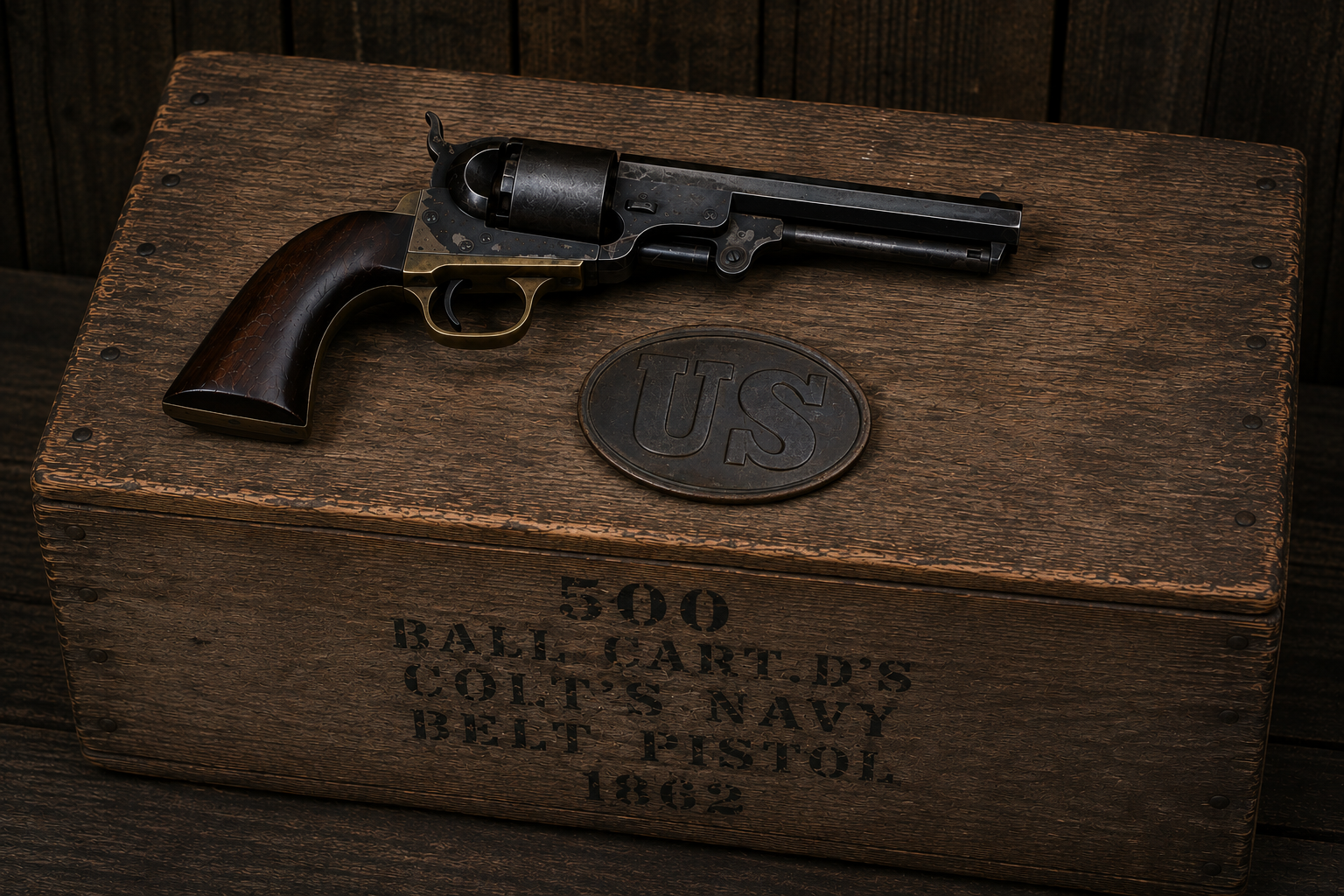
A Model 1851 Colt Navy revolver and a US belt plate resting on an 1862 Colt's Navy cartridge crate

Est. 2026

Old Republic Gallery — Hold a Piece of American History

Authentic Excavated & non-excavated artifacts, relics, and antiques from America's past. Every piece is guaranteed genuine.

Featured Artifacts

The Collection

Obverse of the April 6, 1863 Confederate States of America $5 note

April 6th 1863 Confederate States of America $5 Note

An original Confederate States of America $5 note dated April 6, 1863. This note is in good condition and features the Confederate Capitol Building, now the Virginia State Capitol, at the top center of the obverse, along with a portrait of Christopher Gustavus Memminger, Confederate Secretary of the Treasury, at the bottom right.The reverse features five numeral “5” designs with a large Roman numeral “V” at center. The note displays well and has no rips or tears present.The wording on the obverse reads:“FUNDABLE IN STOCKS OR BONDS OF THE CONFEDERATE STATES.TWO YEARS AFTER THE RATIFICATION OF A TREATY OF PEACE BETWEEN THE CONFEDERATE STATES & THE UNITED STATESThe Confederate States of AmericaWILL PAY TO Bearer FIVE DOLLARS.Richmond 5RECEIVABLE IN PAYMENT OF ALL DUES EXCEPT EXPORT DUTIES.”Printed by Keating & Ball of Columbia, South Carolina.

Sold$75.00
Obverse of the actual CSA 1864 $20 Bank Note

CSA 1864 $20 Bank Note

A very nice original Confederate States of America $20 note dated February 17, 1864. The obverse features the Tennessee State Capitol building at center, with text contained within two shields above. A portrait of Confederate Vice President Alexander H. Stephens appears at the lower right, with denomination markings at the left and upper right.The note features both printed Latin script and period cursive script.The principal wording reads:“Two Years after the Ratification of a Treaty of Peace betweenThe Confederate States and the United States of America,TheCONFEDERATE STATES OF AMERICAWill pay TWENTY DOLLARS to the beareron demand. Richmond. February 17th 1864.”The reverse is printed in blue ink and features a large “TWENTY” at center with the denomination “20” in all four corners, superimposed over an intricate guilloche design.This example remains in great overall condition for its age. There are a few visible creases and very minor tears confined to the edges, consistent with period circulation and handling. Please refer to the photographs for exact condition.

Sold$75.00
Front of flawless non-excavated Confederate staff officer's coat button with full gilt finish on solid black background

Flawless Non-Excavated Confederate Staff Officers Coat Button

A flawless, non-excavated example of a Civil War-era Confederate staff officer’s coat button, manufactured in England and imported for Confederate use. This button is in exceptional condition, with no damage and its full gilt finish remaining. The reverse retains a straight, upright shank and bears an “Extra Rich Treble Gilt” backmark. Measures 25 mm in diameter. An outstanding example that would be difficult to improve upon.

$275.00
U.S. C.C.S. 1862 inspector and date markings on the Mansfield & Lamb cavalry saber

1862 U.S. Model 1860 Light Cavalry Saber — Mansfield & Lamb

An original 1862-dated U.S. Model 1860 Light Cavalry Saber manufactured by Mansfield & Lamb of Rhode Island. Originally a producer of farm scythes, the firm secured a government contract and delivered approximately 37,458 cavalry sabers between February 1862 and the end of the Civil War. Only about 10,000 were manufactured in 1862, with the production issued for wartime service. 1862 is the most desirable year of this series of M1860s. This example displays extensive wear to the scabbard and drag, consistent with prolonged field use dragging against the ground while the soldier walked. Roughly 90% of the original leather grip remains, although the wire wrapping is missing and the wood underneath the leather is visible in spots with heavy wear. The maker's mark, date, and inspector's initials remain clearly visible and beautifully preserved. The scabbard is free of major damage, with only a small nick and a slight dent towards the scabbard throat, which does not affect the saber sliding cleanly in and out of the scabbard. The edge of the guard is bent upwards, a common soldier alteration which allowed for more comfortable carrying. The blade edge has a couple of minor nicks. Overall, this is a spectacular and heavily used artifact of the American Civil War with outstanding historical character.

Sold$800.00
Mansfield & Lamb maker's mark stamped on the ricasso of the 1864 Model 1860 light cavalry saber

1864 Mansfield & Lamb Model 1860 Light Cavalry Saber

A beautiful, Civil War–dated Model 1860 Light Cavalry Saber manufactured in 1864 by Mansfield & Lamb of Rhode Island. Originally a producer of farm scythes, the firm secured a government contract and delivered approximately 37,458 cavalry sabers between February 1862 and the end of the Civil War. This example displays honest wear from extensive field use, particularly along the scabbard and drag. The wire-wrapped leather grip shows wear and a crack on the reverse. The maker's mark, 1864 date, and inspector's initials remain exceptionally clear. The scabbard is free of dents and bends, while the blade has no notable damage and retains a sharp edge. Overall, this is a spectacular and well-preserved artifact of the American Civil War that undoubtedly saw service.

Sold$1,100.00
U.S. Model 1840 Heavy Cavalry Saber — overhead view of the brass three-branch guard and blade

U.S. Model 1840 Heavy Cavalry Saber — "Wristbreaker" — Shiloh Battlefield Provenance

U.S. Model 1840 Heavy Cavalry Saber, commonly known as the "Wristbreaker," with verbal provenance as an early battlefield pickup from the Battle of Shiloh. Fought April 6–7, 1862, Shiloh pitted approximately 45,000 Confederates against 65,000 Union soldiers and resulted in nearly 24,000 casualties. The staggering violence and loss of life shocked the nation, making Shiloh the bloodiest battle in American history up to that time. According to its verbal provenance, this saber was recovered from the Shiloh battlefield. The scabbard and original leather grips are missing, likely from exposure to the elements before its recovery. Measurements: Overall Length: 42" Blade Length: 35½" Provenance Note: The Shiloh battlefield association is based on verbal provenance accompanying the artifact and is not independently documented.

$600.00
M1840 U.S. Heavy Cavalry Saber Wristbreaker by Schnitzler & Kirschbaum

M1840 U.S. Heavy Cavalry Saber “Wristbreaker” — Schnitzler & Kirschbaum

This M1840 U.S. Heavy Cavalry Saber, nicknamed the “Wristbreaker” because of its substantial weight, was reportedly found concealed within the walls of a Civil War period plantation home in northern Mississippi. The saber was manufactured by the prominent German firm Schnitzler & Kirschbaum of Solingen, which supplied early contract blades to the United States. The firm’s “S&K” marking remains visible on the bottom of the scabbard drag. The blade is in good condition and retains a sharp point. The hilt is missing its original wooden and leather grip. Because the leather washer between the blade and guard is also missing, the two components rattle slightly. The scabbard displays several minor dents, and a firm pull is required to unsheathe the saber. Both scabbard suspension rings remain intact. Although the saber’s provenance is verbal, its condition is consistent with an attic or barn find. It was protected from direct exposure to the elements but was not properly stored. Based on its reported discovery location, it may have been concealed during the Civil War to prevent its capture or confiscation. The M1840 Heavy Cavalry Saber was among the most widely used cavalry swords of the American Civil War. This examples overall condition is fair and consistent with its reported provenance.

$625.00
Confederate Staff Officer’s coat button obverse showing droop-wing eagle with remnants of gold gilt

Confederate Staff Officer’s Coat Button — Civil War

An original Civil War Confederate Staff Officer’s coat button featuring the classic droop-wing eagle design. This locally made example was produced by an unidentified Confederate contractor and retains a substantial amount of its original gold gilt. The tin reverse loop has rusted away, as is commonly encountered on excavated examples after more than 160 years underground.

$180.00
Front view of original Model 1858 Civil War canteen with canvas cover

Original Model 1858 Civil War Canteen

A great-condition, all-original Model 1858 smoothside canteen from the American Civil War (1861–1865). This pattern was widely used by both Union and Confederate troops throughout the conflict. Remarkably, the canteen retains its original canvas covering and a large portion of the original carrying strap. The canvas shows several holes and small areas of loss but remains largely intact. The tin body is exceptionally well preserved, with only a small chip to the pewter spout as shown in the photographs. An outstanding, untouched 160+ year-old piece of Civil War history.

Sold$180.00
Excavated Civil War iron canister shot examples

Civil War Excavated Cannon Canister Shot

A large excavated Civil War iron canister shot recovered from the ground. Canister rounds consisted of numerous iron balls packed inside a tin canister and were fired at close range, effectively turning a cannon into a massive shotgun. Used by both Union and Confederate artillery, canister was one of the most devastating anti-infantry munitions of the Civil War. Sold individually. Pictured: representative examples; each shot is excavated and varies slightly in surface patina. Pieces measure about 1.5" diameter. You will receive one of the examples shown, while supplies last.

$15.00
Front view of the Civil War Confederate Staff Officer's coat button by Casimir Rouyer, New Orleans

Civil War Confederate Staff Officer's Coat Button – Casimir Rouyer, New Orleans

A beautiful, intact two-piece Confederate Staff Officer's coat button manufactured by Casimir Rouyer of New Orleans, Louisiana. Buttons of this type were likely worn by Confederate officers from Louisiana, Mississippi, and Alabama. This 22mm example retains a smooth brown patina and is in excellent overall condition. The face has a small dent and tiny crack near the 5–6 o'clock position, while the original shank remains intact but is bent over on the reverse. A scarce and evocative piece of Confederate material culture from the American Civil War.

$180.00
Civil War Springfield Bayonet – Fredericksburg Battlefield

Civil War Springfield Bayonet – Fredericksburg Battlefield

A Civil War-period excavated Springfield socket bayonet, made for use with the Springfield rifle-musket. This example was recovered near the Fredericksburg, Virginia battlefield in 1952. Despite its excavated condition, the bayonet remains completely intact and retains a remarkably fine tip. An excellent battlefield-associated relic from one of the Civil War's most significant campaigns.

$175.00
Civil War Springfield socket bayonet, Atlanta Campaign — socket detail

Civil War Springfield Bayonet – Atlanta Campaign

A Civil War-period excavated Springfield socket bayonet, made for use with the .58 Springfield rifle-musket. This example was recovered near Atlanta, Georgia—the site of the bloody 1864 Atlanta Campaign and the opening chapter of Sherman’s advance through Georgia. Despite its excavated condition, the bayonet remains completely intact and retains a remarkably fine tip. An excellent battlefield-associated relic from one of the war’s most consequential campaigns.

$175.00
Excavated Civil War U.S. cartridge box plate, face with raised US insignia

Civil War U.S. Cartridge Box Plate

An exceptionally well-preserved excavated Civil War U.S. cartridge box plate. Bearing the iconic raised "US" insignia, these plates were mounted to the leather flap of a Union soldier's cartridge box, serving both as insignia and as added weight to help keep the flap closed. The face displays beautifully for an excavated example, retaining excellent detail and an attractive aged patina. One original iron fastening loop remains intact on the reverse, while the other has rusted away during its many years underground. A classic and highly recognizable piece of Union Civil War equipment. This piece was excavated in Culpeper, Virginia. Note: The final photograph is an EXAMPLE reference image showing a plate mounted on an original cartridge box for context only — it is not the item being sold and is not included.

$225.00
Civil War U.S. cartridge box plate, excavated near Atlanta, Georgia — face with raised US insignia

Civil War U.S. Cartridge Box Plate - N. Georgia

An exceptionally well-preserved excavated Civil War U.S. cartridge box plate bearing the raised "US" insignia. These plates were mounted to the leather flap of a Union soldier's cartridge box, serving as both insignia and added weight to help keep the flap closed. This example was excavated near Atlanta, Georgia. The face displays beautifully for an excavated piece, retaining excellent detail and an attractive aged patina. The original iron fastening loops on the reverse have rusted away during its time underground. Note: The final photograph is an EXAMPLE reference image showing a U.S. cartridge box plate mounted on an original Civil War cartridge box. The cartridge box shown is for illustration only and is NOT included with this purchase — only the cartridge box plate pictured in the first two photographs is being sold.

$200.00
Civil War Era Union General Service cuff buttons — eagle faces

Civil War Era Union General Service Cuff Button

An original, non-excavated brass Union General Service uniform button from the American Civil War. This two-piece pattern was issued to U.S. soldiers from 1854–1865 and features a correct period manufacturer’s backmark. The face displays the classic spread-wing Federal eagle with a shield upon its chest, clutching arrows and an olive branch in its talons. This is the smaller cuff-size variation, measuring approximately 14mm in diameter. Each button is sold individually. You will receive one of the examples shown, while supplies last.

$12.00
Reverse of an 1862 British Maundy fourpence showing the crowned numeral 4 and date within an oak wreath, with a punched hole

1862 British Maundy Fourpence – Sterling Silver

An 1862 British Maundy fourpence struck in .925 sterling silver. Although silver, the coin displays an attractive golden luster and may have been gilded. A punched hole and two visible attachment points indicate that it was likely incorporated into a piece of jewelry. Maundy coins are specially issued for the Royal Maundy ceremony, during which the British monarch presents small silver coins to elderly recipients on Maundy Thursday. Traditionally issued in denominations of one through four pence, the number of recipients corresponds to the monarch's age.

Sold$50.00
Exterior view of the Confederate 12 lb cannonball half showing the Bormann fuze threading detail

Exploded Confederate 12 lb. Cannonball Half

A unique half of an exploded Confederate 12-pound Bormann-fuzed cannonball. This 4.5-inch-caliber shell was fired and exploded during the 1863–1864 fighting north of Atlanta. Although the Bormann fuze was a Union invention, captured examples allowed Confederate arsenals to reproduce the design. This example displays a gap between the upper fuze threads and the underplug threads, which accommodated a leather washer not found on Union examples. It is highly unusual to find a cannonball split so evenly through the center. The interior also retains traces of its original black pine tar, which was used to hold the lead case-shot balls in place.

$100.00
Exploded Union 12lb Bormann-fuzed cannonball fragment showing threaded fuze seat and interior surface

Exploded Union 12lb Bormann-Fuzed Cannonball Fragment

A large fragment—approximately 35–40%—of an exploded Union 12-pound Bormann-fuzed cannonball. Excavated in North Georgia near Atlanta, this shell was likely fired during the heavy fighting of 1863 or 1864.

$65.00
Excavated Confederate cast block "I" infantry button face showing the raised Roman-style letter I

Confederate Cast Block "I" Infantry Button

An excavated Confederate Roman-style cast-brass block "I" infantry button. Primarily associated with the Army of Tennessee in the Western Theater of the Civil War, these buttons were cast from a single piece of brass rather than using the typical two-piece construction commonly seen on uniform buttons of the era. This example was recovered from a Confederate campsite in North Mississippi. The attachment loop is missing.

Sold$50.00